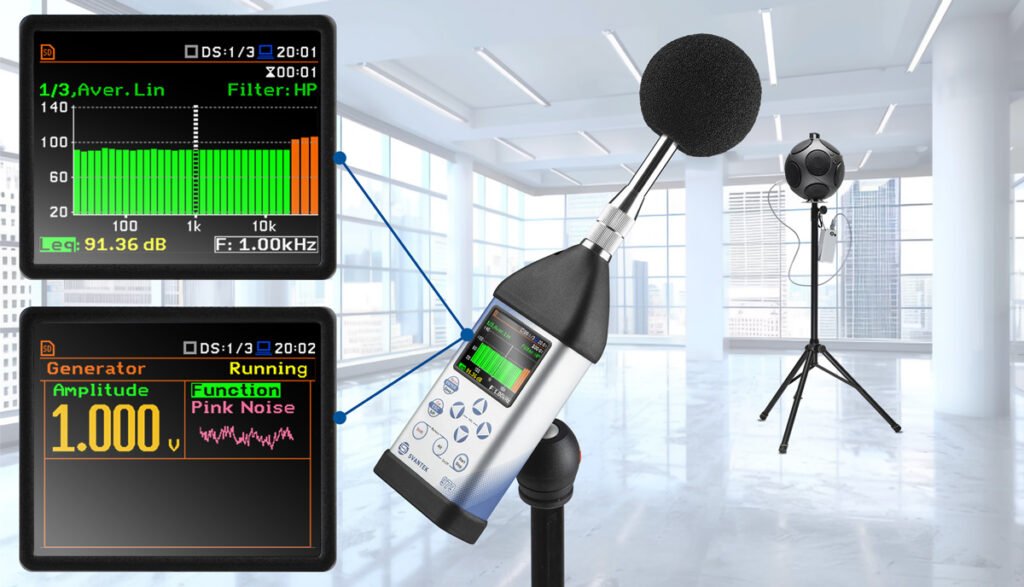

Whether individuals or organisations make use of handheld noise level meters to check sound levels at particular locations, or instruments capable of recording noise over extended periods, they can’t ignore or overlook the importance of taking the right measurement approach.
Indeed, the choice that they make in this regard will likely impact greatly on their findings, and therefore the subsequent noise-control decisions taken.
Noise Assessment Approaches: The UK Context
Let’s look at the situation in the UK, on which much of this guide will focus. The effective management of workplace health and safety in this country depends on a considerable extent on accurately assessing the noise to which on-site personnel are subjected.
The Control of Noise at Work Regulations 2005 oblige employers to assess the risks associated with noise exposure, alongside the implementation of appropriate measures to protect employees.
Nonetheless, for businesses both in and outside the UK, it can be greatly helpful to know the differences between spot readings and continuous logged noise data.
The choice that a given organisation ultimately makes between these approaches will hinge on the purpose, duration, and regulatory requirements of the situation at hand.
A Quick Introduction to Spot Noise Readings
Spot readings are sometimes referred to as “instantaneous” or “short-term” measurements. They involve using a sound level meter to take discrete sound pressure level samples at specific locations and times.
The operator holds or positions the noise measurement tool where noise needs to be assessed. The reading is then captured over a few seconds or minutes (often as an equivalent continuous level, LAeq, or maximum level), followed by the process being repeated at other points or times in line with requirements.
As the term “spot reading” implies, this process is essentially about providing a snapshot of noise conditions at the time of measurement. It is a quick and convenient method necessitating minimal setup, all of which helps make it useful for:
- Initial surveys to pinpoint noisy areas
- Checking compliance at fixed workstations as part of a walk-around
- Verifying how effective noise controls are after modifications
- Responding fast to a complaint or suspected problem
One advantage of spot readings is that a user only requires a basic Class 1 or Class 2 sound level meter to carry one out. The data arising from this can be recorded manually or stored in the instrument’s memory.
But of course, as an individual spot reading is only a snapshot, it might not reflect the full extent of workers’ noise exposure in certain situations. These include varying production processes over the course of a day, machinery operating intermittently, or noise levels fluctuating from the start to end of a typical shift.
See also: Business Litigation Lawyer: A Practical Guide to Handling Business Disputes
A Quick Introduction to Logged Noise Data
Also known in some quarters as “continuous” noise data, logged noise data entails the recording of sound measurements continuously or at predetermined intervals over a specified period. For this purpose, a sound level meter or noise dosimeter is typically left in place to record noise data over hours, a full shift, or days.
Depending on the measurement tool used, readings may be stored internally for later analysis or transferred to software for more in-depth scrutiny. The given instrument may retain time-history data, calculate statistical parameters (such as LAeq, LAmax, LA10, or LA90), and/or provide frequency analysis or event triggers.
In contrast to spot readings, an approach of gathering logged noise data is very much about providing a broader picture of how noise levels change over time.
Employers pursuing this approach can therefore more easily see variability across an entire working period that they might have missed if they had relied on individual measurements alone.
All this means a logged noise data approach tends to be favoured for situations like:
- Personal noise exposure assessment (daily or weekly LEP,d)
- Environmental noise surveys for planning or BS 4142 assessments
- Determining where intermittent or cyclical noise is coming from
- Demonstrating compliance with exposure action and limit values over a representative period
Logged measurements can be useful where noise exposure is variable or tricky to predict. They can also greatly help with investigations into intermittent noise sources and can be key to establishing whether certain activities coincide with periods of elevated noise levels.
Another major benefit of this approach is the evidence base that recorded data can provide for reviewing once the monitoring session has concluded.
Many of the latest available sound level meters support data logging. Graphs, percentile levels, and reports can also often be produced, which can help the work of Health and Safety Executive (HSE) inspectors or local-authority environmental health officers.
In Which Circumstances Should You Opt for One Approach Over Another?
Here, then, is a quick reference for responsible individuals seeking to choose the right measurement approach for their situation:
- Spot readings tend to make most sense for rapid screening, the identification of hotspots, checking the suitability of hearing protection in specific zones, or confirming that engineering controls have reduced a given noise source.
- Logged data should typically be preferred whenever there is a need to assess worker exposure against the lower and upper exposure action values, prepare formal noise assessments, investigate complaints in relation to variable noise, or gather evidence for planning or abatement notices.
Finally, it is important to remember that in certain contexts, a combination of both approaches might be the optimal course of action.
For example, a given situation may lend itself to initial spot readings to map the area, followed by the deployment of logging instruments on individuals or at critical locations to allow for detailed quantification.