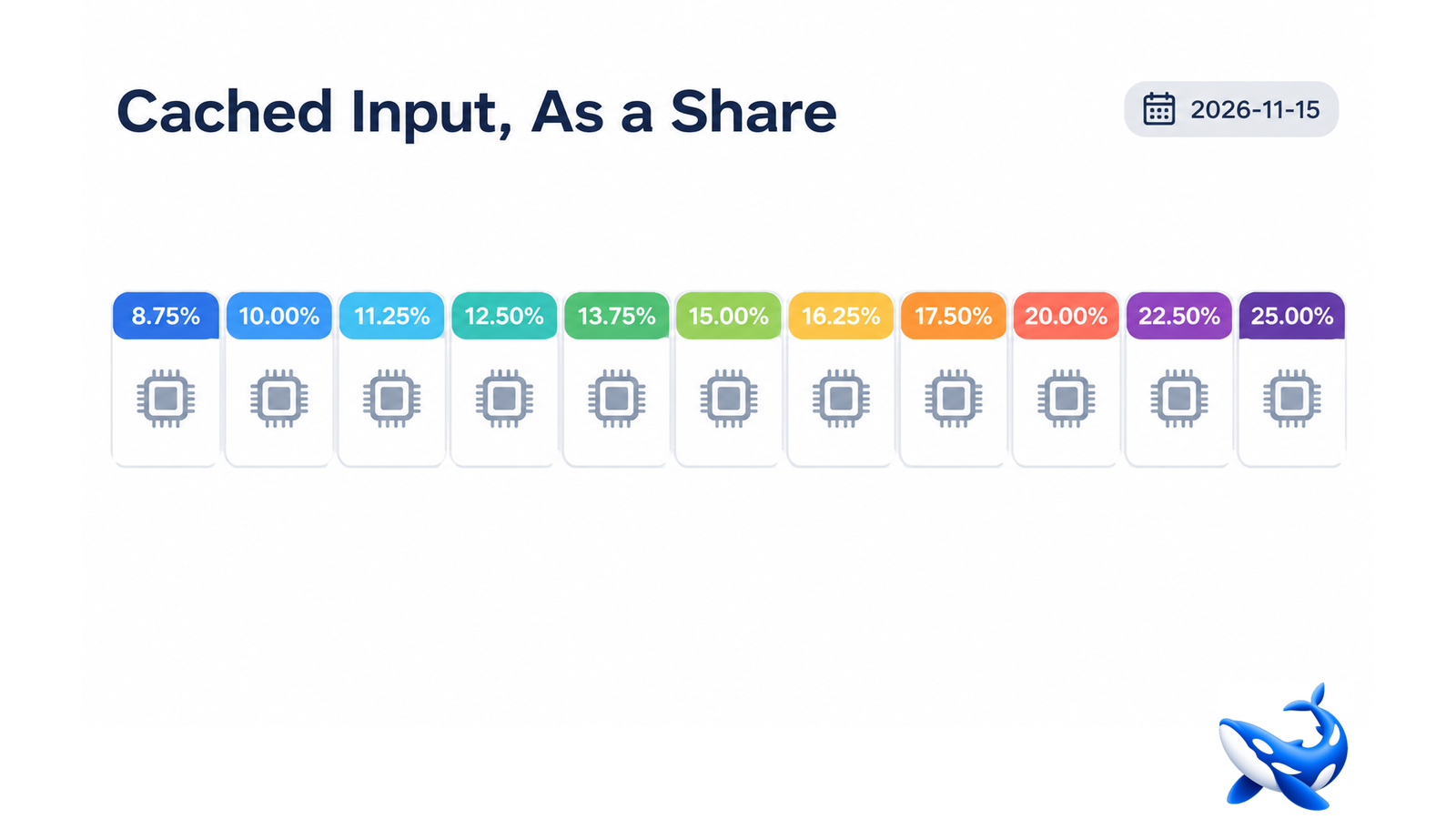

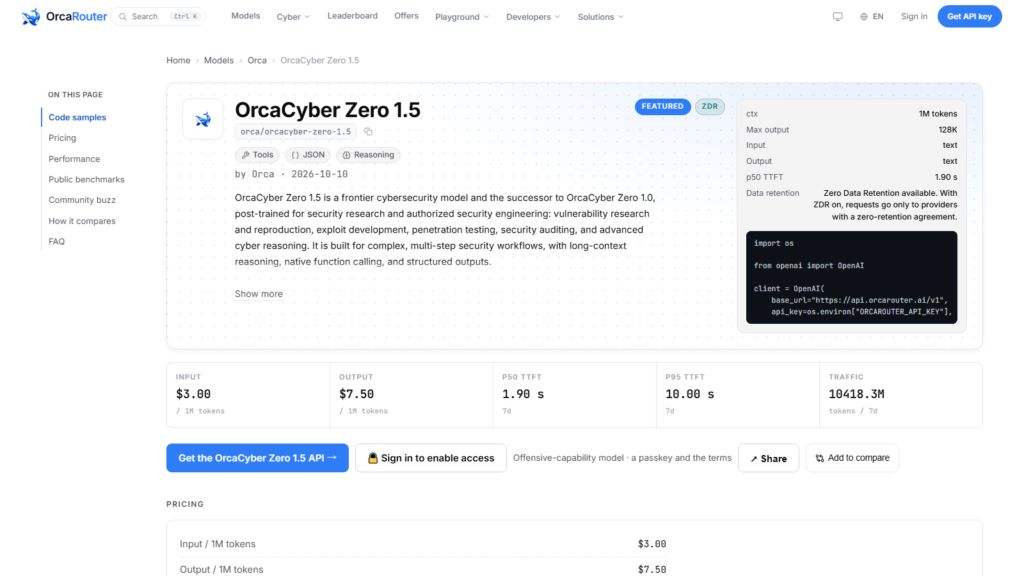
Cache read is quoted as a per-million price on every model card, and that is the least useful way to read it. On OrcaRouter‘s cyber tier the read rate as a share of the input rate runs from 8.75% on Kimi K3.1 Pro abliterated pricing to 25.00% on Zero 1.0 and Zero 1.5, with every card in between at 15.00% or 18.75% [OURS]. That share is what your effective bill depends on once a workload has a stable prefix.
The full ranking
| card | cache read $/1M | input $/1M | share |
| Kimi K3.1 Pro | 0.35 | 4.00 | 8.75% |
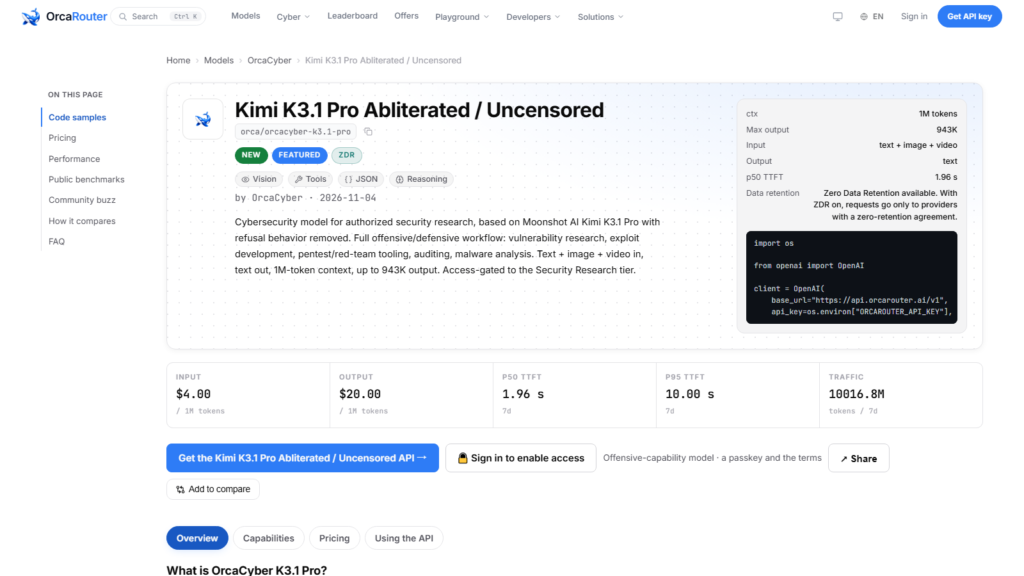
| GLM 5.3 | 0.30 | 3.00 | 10.00% |
| Ultra 1.0 | 0.75 | 5.00 | 15.00% |
| DeepSeek V4.1 Flash | 0.15 | 0.80 | 18.75% |
| Qwen3.8 Flash Next | 0.15 | 0.80 | 18.75% |
| GLM 5.3 Flash | 0.15 | 0.80 | 18.75% |
| MiMo V2.6 Flash | 0.15 | 0.80 | 18.75% |
| MiniMax M3.1 Flash | 0.15 | 0.80 | 18.75% |
| Hy4 | 0.15 | 0.80 | 18.75% |
| Zero 1.0 | 0.75 | 3.00 | 25.00% |
| Zero 1.5 | 0.75 | 3.00 | 25.00% |
[OURS], read 2026-11-15.
What the share controls
The effective input price for a workload with a stable prefix is a weighted average of the cached and uncached rates.
At a cache hit rate h, effective input = (1 − h) × input + h × cache read. Substituting the share s for cache read:
effective input = input × (1 − h + h × s)
At h = 0.8 and s = 0.1875, the multiplier is 0.35 — you pay 35% of list. At the same hit rate and s = 0.25, it is 0.40. At s = 0.0875, it is 0.27.
So the difference between the best and worst share here is about 13 percentage points of your input bill at an 80% hit rate. On a card at $0.80 input, that is the difference between $0.28 and $0.32 per million effective — four cents. On a card at $4.00, it is the difference between $1.08 and $1.60 — fifty-two cents.
The share matters in proportion to the price, which is why the cards with the best shares are also the expensive ones.
Why Kimi’s 8.75% is the quiet advantage
At $4.00 input and a 90% hit rate, Kimi’s effective input is $0.715 per million [OURS, our arithmetic]. At 80% it is $1.08.
Compare DeepSeek at $0.80 with an 18.75% share: at 80% hit rate the effective input is $0.28. Kimi is still four times more expensive per effective input token — the better share does not overturn a five-fold price difference.
What it does is narrow the gap for cache-heavy work specifically. A workflow with a 95% hit rate — a fixed system prompt, a fixed tool schema, a small question — pays Kimi $0.53 against DeepSeek’s $0.19. The ratio is 2.8× rather than 5×.
That is the kind of arithmetic that turns “Kimi is for long outputs only” into “Kimi is for long outputs, or for short questions against a very stable context”.
Why the two Zero cards sit at 25%
Because their cache read is fixed at $0.75 and their input is only $3.00 [OURS]. The absolute cache price matches Ultra’s, but Ultra’s input is $5.00, which brings the share down to 15.00%.
That is the one place in the tier where the absolute cache price is identical across cards with different input rates, and it produces the widest share spread among cards at similar prices.
For a buyer the practical consequence is that the Zero cards are the worst cache value in the tier at 25%. A workflow with a heavy static prefix should look at Kimi or GLM 5.3 before it looks at Zero, even though the Zero cards are cheaper per input token.
What a static prefix is worth
A cached prefix has to be stable across calls. Three things qualify, and security pipelines have all three more often than they realise.
A system prompt. Fixed text at the front of every call. If it is 400 tokens and you make 10,000 calls a day, that is four million tokens a day of cacheable input — $0.60 a day at DeepSeek’s cached rate against $3.20 fresh.
A tool schema. A set of tool definitions is long, static and identical on every call in a session. It is the largest single cacheable block in most agents.
A repository or corpus summary. A generated overview that is regenerated rarely and reused for every query against that codebase.
The three combined are often 20,000 to 50,000 tokens. At 10,000 calls a day, that is 200 to 500 million tokens of cacheable input — the difference between a workload costing $60 a day and $400 a day on the same card.
The engineering is one thing: put the stable material first and never let anything vary inside it. A timestamp or a request id at the top of the prompt invalidates the whole prefix.
How to measure your real hit rate
The cache share only matters at your hit rate, and vendors report the price rather than the rate.
Two measurements, both cheap.
Log the `cached_tokens` field if the response carries it, and compute the ratio to total input tokens per call. That is your hit rate, by workload.
Vary one thing at a time. Add a timestamp to the system prompt and watch the rate fall to zero; remove it and watch it return. That experiment tells you what in your prompt is invalidating the prefix, which is usually not what the team assumed.
Both belong in the first week of a deployment, because the hit rate is the parameter that turns a price list into a bill.
The four cards where the share flips the ranking
The share is a multiplier, so it can only reorder cards whose list prices are close. Four such pairs exist on this tier, and each flips at a different hit rate.
Zero 1.0 against GLM 5.3. List price $3.00 against $3.00 — identical. At 0% cache use they cost the same. At 50% hit rate, Zero’s effective input is $1.88 and GLM’s is $1.65. At 90%, $1.05 against $0.84 [OURS, our arithmetic]. GLM 5.3 wins the cache-heavy case and ties otherwise, which is why its 10.00% share is the quiet advantage in the middle of the price ladder.
Ultra 1.0 against Zero 1.0. $5.00 against $3.00, but 15.00% against 25.00%. At 95% hit rate, Ultra’s effective input is $0.96 and Zero’s is $0.87. The 1.67× list-price gap collapses to 1.1× once the prefix is stable — the narrowest spread anywhere in the tier, and the one that most changes a buying decision.
Kimi against itself. Its 8.75% share means a cache-heavy Kimi workload is a different product from a cache-light one. At $4.00 list, the input cost at 0% hit rate is four times the cost at 90%. A team that rejected Kimi on price at 20% hit rate may find it affordable at 90%.
The flash tier against nothing. All six sit at 18.75%, so nothing flips among them. Their cache economics are identical and their choice should be made entirely on other rows — a fact worth stating because the identical price column makes it easy to assume identical behaviour everywhere.
The general rule that falls out: compare cards on effective input at your hit rate, not on list input. On this tier that reorders four pairs and changes a buying decision in at least two.
The four cards where the share flips the ranking, before you commit
A short method, because the arithmetic above is easy to get wrong at the edges.
Write down your hit rate from a week of logs, not from an estimate. Multiply each card’s input rate by (1 − h + h × share). Rank.
Then check the second-order effect: a larger cached prefix costs more to write. Cache writes are usually billed at or near the input rate, so a prefix only pays off after it has been read more than once. On Kimi, a 50,000-token prefix costs $0.20 to write and $0.0175 to read — it pays back on the second call.
That payback threshold is the number to compute before a big-prefix design, and it is short on every card here: one extra call.
The one-line version
Cache share runs 8.75% to 25% across eleven cards. It multiplies your input rate rather than replacing it, so it matters most where the input rate is high.
Kimi and GLM 5.3 have the best shares; the two Zero cards have the worst. A 90% hit rate on Kimi costs $0.715 per million effective against $4.00 list.
Put the stable material first and check that nothing varies inside it. The share is a vendor’s promise; the hit rate is yours to earn.
Sourcing note: prices, cache rates, context windows, output ceilings, modalities, quality scores, latency, throughput, error rates and traffic are read from the eleven cards’ public model data on 2026-11-15 [OURS]. Effective-input arithmetic is our own at the hit rates stated. No benchmark rows are quoted.