Newsletter Subscribe
Enter your email address below and subscribe to our newsletter
Enter your email address below and subscribe to our newsletter

 ByJohn A
Most electronics get cleared out in a burst of decisiveness that runs out partway through. The laptops and phones go somewhere sensible. The rest of it, meaning the enormous old television, the printer that never worked properly, the box of unidentified cables, and the jar of assorted batteries, stays exactly where it is because none of it fits the plan.
These items are awkward for real reasons rather than imagined ones. They are heavy, they are handled differently by different facilities, several of them are genuinely hazardous, and the rules governing them vary by region more than the rules for computers do.
Local recycling searches tend to return general collection points that accept the easy categories, which is why these specific items so often end up stranded. Knowing how each is treated, and why, makes the difference between clearing them properly and moving them to a different corner of the garage.
Display equipment is the most commonly refused item at collection points, and the reason is economic rather than technical.
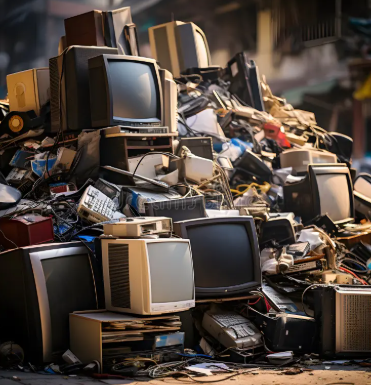
Older cathode ray tube sets contain several kilograms of leaded glass. That glass has almost no market value, must be handled as hazardous material, and costs money to process. A facility accepting a large tube television is taking on a net cost, which is why many charge a fee or decline entirely.
Flat panels are lighter but bring their own issue. Panels with fluorescent backlighting contain mercury in the lamps, which requires controlled removal. Modern LED-backlit panels avoid this, but sorting by backlight type is not something a member of the public can do reliably, so facilities often treat all panels cautiously.
The practical approach is to call ahead specifically about display equipment rather than assuming, expect a possible fee for older units, and never leave a screen at the kerb. Broken display glass is a genuine hazard for waste handlers.
Printers are awkward for a different reason: they are a mixed material problem with a data problem hidden inside.
The physical device is mostly plastic with a modest amount of metal, which makes it low value to process. Toner and ink present a contamination issue, and toner powder in particular is unpleasant and messy if a cartridge ruptures during handling.
The part people miss is storage. Office multifunction devices frequently contain hard drives that retain images of everything scanned, printed, copied, or faxed through them. A machine that has served a business for five years holds a substantial archive of documents, and it is routinely disposed of with no thought given to that.
Before disposing of any office copier or multifunction device, establish whether it contains storage and have that storage removed and destroyed, or use the manufacturer’s documented sanitization procedure. Remove cartridges separately, since most manufacturers and many retailers run return programs for them.
Batteries are the item most likely to cause actual harm, and they are the item handled most casually.
Lithium cells are the concern. Under compression, puncture, or heat they undergo thermal runaway, which is a self-sustaining reaction that is extremely difficult to extinguish. Fires in collection vehicles and sorting facilities caused by discarded lithium cells have become a serious and growing problem across the waste industry.
Never place batteries of any chemistry in general waste or in a mixed recycling bin. Tape the terminals of loose cells with clear tape before storing them, which prevents short circuits between contacts in a container.
Treat swollen cells as urgent rather than routine. A bulging battery, whether loose or inside a device, should go to a collection point promptly and staff should be told about it so it can be placed in a fire-rated container.
Most regions have dedicated battery drop-off points at hardware stores, electronics retailers, and municipal depots, and these are usually easier to find than general electronics collection.
Almost every household has a container of cables nobody can identify, kept on the theory that one of them will eventually be needed.
They are worth recycling rather than discarding, because cable is dense in copper and copper recovery is straightforward and economically worthwhile. Most collection points accept cables readily, and they are among the easier items to process.
Before disposing of them, it is worth a quick sort. Standard modern charging cables and adapters in working condition are genuinely useful to someone, and community reuse programs will take them.
Anything with damaged insulation should go to recycling rather than reuse, since exposed conductors are a fire and shock risk regardless of how functional the cable appears.
The reason these items linger is that each one seems to require its own separate errand, and none of them individually justifies the trip.
The efficient approach is to sort everything into categories first, then make one call to a facility that handles the widest range of them, and confirm what they will and will not take before loading. That single conversation usually collapses four errands into one, and it turns the leftover pile into a task with a defined ending rather t