Newsletter Subscribe
Enter your email address below and subscribe to our newsletter
Enter your email address below and subscribe to our newsletter

 ByJohn A
The base of a pan rarely gets as much attention as its cooking surface, yet it has a direct effect on how cookware behaves over heat. A nonstick coating can help with food release, but the structure underneath it determines how the pan responds to heat, how evenly it sits on a cooktop, and how consistently food cooks across its surface.
Double Impact nonstick cookware combines a reinforced nonstick surface with a patented Double Impact Base. The design uses stainless steel and aluminum construction to provide a flat, stable cooking platform while supporting consistent heat and browning. The collection is also designed for use across different cooktops, including induction.
Understanding the construction helps explain why the base matters just as much as the coating when assessing premium nonstick cookware.
Double Impact refers to the construction of the cookware base. In the TITUM Fusion collection, the base is made using two stainless steel discs bonded to an aluminum body. The structure is engineered to maintain flatness, resist warping, and provide stable contact with the cooking surface.
A nonstick pan with a carefully engineered base can provide a more controlled cooking experience than one that relies primarily on its coating. Heat transfer, stability, and surface contact all contribute to how ingredients respond during cooking.
The patented Double Impact Base consists of two stainless steel discs bonded to an aluminum body. This construction is designed to keep the cookware flat while helping it withstand the demands of repeated heating.
The base also helps maintain contact with the cooktop. This becomes particularly useful on induction surfaces, where direct contact between the cookware base and the cooking zone is essential for efficient heat transfer.
Another feature of the base is its ability to keep oil centered in the pan. The design supports more even oil distribution across the cooking area, which can be useful for sautéing, searing, and browning.
The cooking surface is only one part of a pan. The body and base determine how the pan responds once heat is applied.
A base that maintains its shape can provide more predictable contact with the cooktop. That can contribute to consistent heating and reduce areas where food receives substantially more or less heat than intended.
Material selection also matters. Aluminum is known for its ability to conduct heat efficiently, while stainless steel provides strength and durability. Combining these materials allows the construction to address different requirements within the same pan.
Heat does not behave identically in every piece of cookware. Pan thickness, material, base design, cooktop type, and surface contact can all influence how quickly and evenly heat reaches the cooking area.
The Double Impact design is intended to provide a stable foundation for consistent cooking rather than treating the base as a simple attachment underneath the pan.
Consistent heat distribution helps reduce significant temperature differences across the cooking surface. This matters for foods that need even browning or controlled sautéing.
The aluminum body contributes to heat conduction, while the stainless steel base provides structural support. Together, the materials are designed to help distribute heat across the pan.
This construction can also make the cooking surface more predictable. A pan that responds consistently to changes in heat gives the cook greater control over the cooking process.
A pan needs to remain stable while sitting on the cooktop. Movement, uneven contact, or changes in shape can interfere with cooking control.
The Double Impact Base is engineered to stay flat and resist warping. Maintaining a flat base helps preserve contact with the cooking surface and supports the structural integrity of the pan.
This is particularly relevant for cookware that is heated and cooled repeatedly. Thermal cycling places stress on cookware materials, making structural design an important consideration for long-term use.
Consistent cooking depends partly on how evenly heat reaches different areas of the pan. A well-designed base can help reduce major variations across the cooking surface.
The cookware is also designed with a broad cooking area. The skillet design offers up to 30% more cooking surface than ordinary skillets, giving food additional room to contact the pan. This can be useful for browning ingredients that benefit from adequate spacing.
A larger effective cooking area also means the pan can accommodate more ingredients without immediately forcing them into a crowded central area.
The base and cooking surface serve different purposes, but their performance is connected. The base controls much of the cookware’s relationship with the heat source, while the nonstick surface determines how food interacts with the pan.
Using both elements together creates a cookware design intended to provide heat performance alongside convenient food release.
The nonstick surface is reinforced with diamond and titanium particles. According to the product information, this surface is designed to be substantially more durable than conventional nonstick coatings, with a stated durability of 22 times that of conventional coatings.
The surface also has a textured finish designed to support searing and browning. This is significant because nonstick cookware is often associated primarily with low-stick foods such as eggs and pancakes.
A properly maintained nonstick surface can make food easier to release and reduce the amount of residue left behind after cooking.
The cooking surface cannot compensate for an unstable or poorly designed base. Likewise, an excellent base does not provide nonstick performance by itself.
The Double Impact construction addresses the structural side of cooking, while the diamond and titanium reinforced surface addresses food contact and release. The combination gives the cookware two distinct performance characteristics that work during the same cooking process.
This approach also explains why cookware specifications should be evaluated as a whole rather than based on the coating alone.
The practical advantages of this construction become apparent in areas such as food release, cleanup, heat control, and repeated use. The value comes from how these features interact rather than from one isolated component.
A nonstick cooking surface reduces the tendency of food to adhere firmly to the pan. This can make delicate ingredients easier to turn and remove.
The reinforced surface is designed to maintain its nonstick properties while providing additional resistance to everyday wear. Easy release can also reduce the need for aggressive scraping during cooking.
Food that releases more easily generally leaves less stubborn residue behind. The cookware’s nonstick surface therefore contributes to a simpler cleaning process.
The collection is dishwasher safe, adding another convenient cleaning option. Even with dishwasher compatibility, following appropriate care practices can help preserve the surface over time.
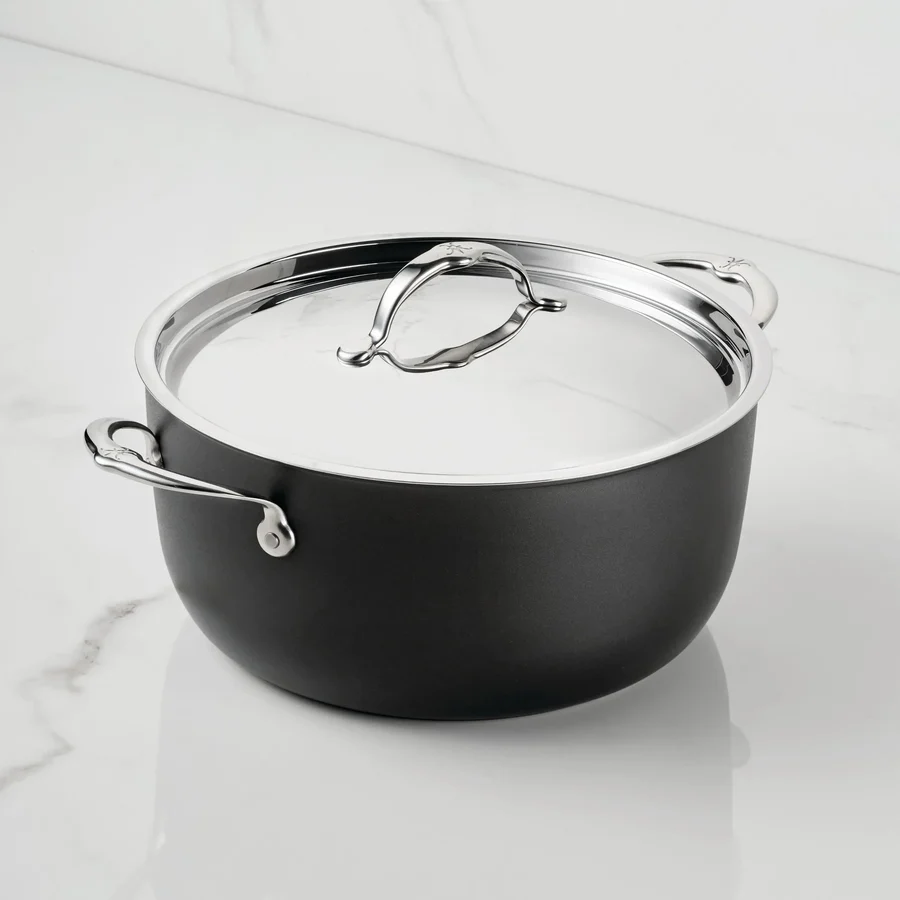
The Double Impact design is not restricted to one cooking technique. The cookware collection includes skillets, saucepans, an essential pan, a stock pot, and a wok.
These formats support different preparations, from frying and sautéing to simmering and larger-volume cooking. The reinforced surface also supports cooking techniques that require browning and searing.
Repeated heating can place considerable stress on cookware. A base designed to resist warping can help maintain the cookware’s shape through regular use.
The reinforced nonstick surface provides another durability-focused element. The manufacturer states that the surface is 22 times more durable than conventional nonstick coatings, while the cookware is backed by a lifetime warranty.
Not all nonstick cookware uses the same construction. Two pans can both be described as nonstick while having substantially different bodies, bases, coatings, and performance characteristics.
A comparison should therefore consider the entire cookware design.
Conventional nonstick cookware may use a simpler base and standard nonstick coating. Double Impact cookware uses two stainless steel discs bonded to an aluminum body, creating a base specifically designed for flatness and stability.
The reinforced diamond and titanium surface adds another distinction. Instead of relying on a basic coating structure, the cooking surface is engineered for increased resistance to everyday wear.
The differences are most relevant during actual cooking. Stable contact with the cooktop can support consistent heating, while the nonstick surface makes food release easier.
The design also aims to support browning and searing, making the cookware useful for more than foods that require gentle cooking.
A cookware comparison should include several factors:
Price alone does not reveal how a pan is constructed or how it is intended to perform.
A reinforced nonstick surface still benefits from proper handling. Good maintenance helps protect the cooking surface and keeps the cookware performing as intended.
Follow the manufacturer’s cleaning instructions and use suitable cookware-safe cleaning methods. The collection is dishwasher safe, but hand washing can also be used when preferred.
Avoid abrasive materials that may cause unnecessary wear. Food residue should be removed without aggressive scraping whenever possible.
Utensils should be suitable for nonstick cooking surfaces. Avoid sharp edges and tools that can scratch or damage the coating.
The flush-rivet design used in the cookware also reduces raised areas inside the pan where food can accumulate. This contributes to a smoother cooking surface and simpler cleaning.
Storage is often overlooked during cookware care. Stacking pans directly against one another can create unnecessary contact between cooking surfaces.
Use suitable protection between stacked pieces when needed, and avoid placing heavy cookware or objects on top of the nonstick surface.
The Double Impact Base is a defining part of the TITUM Fusion collection. It is paired with a diamond and titanium reinforced nonstick surface to address both structural performance and food-release requirements.
The collection is handcrafted in Italy and developed around cooking performance, durability, and versatility.
The collection includes multiple skillet sizes, saucepans, an essential pan, a stock pot, a wok, and cookware sets. This allows the Double Impact construction to be used across different pan formats.
The skillets range from compact 8-inch options to a larger 12-inch size. Deeper cookware includes saucepans and an 8-quart stock pot, while the 12.5-inch wok provides a different shape for cooking techniques that require a broad, curved cooking area.
The range is designed for all cooktops, including induction, giving the collection flexibility across different kitchen setups.
The base and nonstick surface solve separate cooking requirements. The base supports heat management and structural stability, while the surface provides easy food release and resistance to everyday wear.
That division of purpose is central to the cookware’s design. A durable coating alone does not determine cooking performance, just as a stable base does not provide nonstick properties.
For more information about cookware collections, materials, and available products, visit Hestan Culinary.
Double Impact refers to the patented base construction used in the cookware. It consists of two stainless steel discs bonded to an aluminum body. The design is intended to maintain a flat cooking surface, resist warping, and support consistent heating.
Yes. The construction is designed for regular cooking across several techniques, including frying, sautéing, searing, browning, and simmering. The collection also includes several cookware shapes and sizes for different kitchen requirements.
Use appropriate cleaning methods, avoid abrasive materials, select suitable utensils, and protect the cooking surface during storage. The cookware is dishwasher safe, but care instructions should be followed to maintain the nonstick surface.
Yes. The cookware is designed for all cooktops, including induction. The stainless steel base provides the magnetic compatibility required for induction cooking.
The base is designed to provide consistent heat and browning while helping keep oil centered in the cooking area. This construction supports cooking techniques where even heat and good surface contact are important.
The base of a nonstick pan influences much more than how it sits on the cooktop. It affects heat transfer, stability, surface contact, and the consistency of the cooking experience.
Double Impact construction pairs two stainless steel discs with an aluminum body to create a base designed for flatness, stability, and consistent heating. Combined with a diamond and titanium reinforced nonstick surface, the design provides a balance of food release, durability, and cooking performance.
For shoppers comparing nonstick cookware, examining the complete construction can provide a clearer picture than focusing on the coating alone. The base, surface, available cookware formats, cooktop compatibility, care requirements, and warranty all contribute to the overall value of a cookware collection.
For product questions or assistance, visit the contact page.