Newsletter Subscribe
Enter your email address below and subscribe to our newsletter
Enter your email address below and subscribe to our newsletter

 ByJohn A
Humidity control is an essential part of many pharmaceutical manufacturing, processing, packaging, and storage environments. Excess moisture can affect raw materials, powders, tablets, capsules, packaging materials, and equipment. It can also contribute to condensation when surface temperatures fall below the surrounding air’s dew point. A dehumidifier for pharmaceutical industry applications helps remove excess moisture from the air and maintain controlled environmental conditions. The appropriate system depends on the required humidity level, temperature, moisture load, air volume, and specific pharmaceutical process.
Pharmaceutical materials can respond differently to changes in humidity. Some powders and active ingredients can absorb moisture from the surrounding air, while other materials may lose or gain physical properties when exposed to unsuitable conditions. Humidity can also influence the handling, flow, compression, and storage of certain pharmaceutical materials. Maintaining suitable environmental conditions can therefore support consistent processing and product handling.
Humidity control also needs to be considered alongside temperature, airflow, and ventilation. A room may have an acceptable temperature while still containing too much moisture for a particular process. Conventional air conditioning may remove some water vapour, but it may not provide the low humidity required for moisture-sensitive applications. Dedicated dehumidification can provide additional moisture removal where existing HVAC systems cannot maintain the desired conditions.
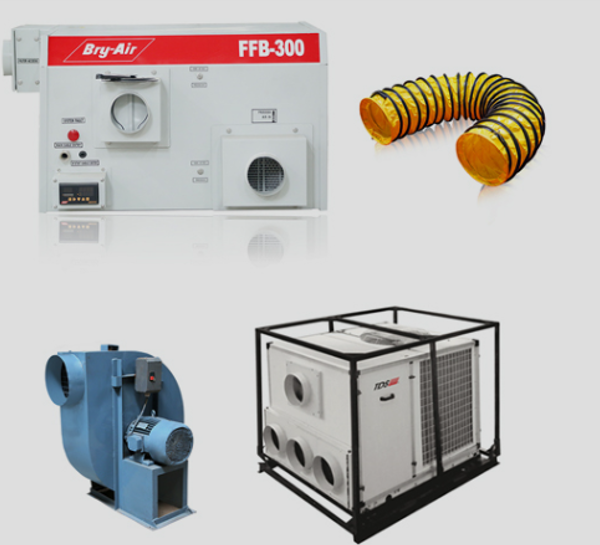
An industrial dehumidifier removes water vapour from air and helps maintain a specified relative humidity. Depending on the system, moisture can be removed through refrigeration-based cooling or through a desiccant material that adsorbs water vapour. The treated air can then be circulated through the required area to maintain controlled conditions.
Pharmaceutical facilities may have different humidity requirements in different areas. Manufacturing rooms, storage areas, packaging spaces, and processing zones can have different moisture loads and operating conditions. Equipment therefore needs to be selected according to the specific application rather than based only on the physical size of the room.
Industrial air solutions can include dehumidification, temperature control, ventilation, and other temporary or project-specific environmental controls. These systems can be designed around the conditions required by a particular industrial process.
Desiccant dehumidifiers use moisture-absorbing materials to remove water vapour from air. Humid air passes through the desiccant, where moisture is captured before the dry air is supplied back into the controlled area. The desiccant is then regenerated so that it can continue removing moisture.
This technology can be useful for applications requiring low and stable humidity. Unlike systems that depend mainly on cooling air below its dew point, desiccant dehumidification can provide dry air under a broader range of temperature conditions. The suitability of the system still depends on the required humidity, temperature, airflow, moisture load, and facility design.
Pharmaceutical facilities contain several areas where moisture control may be required. The exact requirements depend on the materials being handled and the processes taking place. Environmental conditions may also need to remain consistent throughout production, storage, and packaging activities.
Manufacturing processes can involve powders, granules, active ingredients, excipients, solvents, and other materials with different moisture sensitivities. Excess humidity may affect material handling and can create unwanted changes in certain production conditions.
A controlled dehumidification system can help maintain a suitable environment around moisture-sensitive processes. The system should be selected based on the process requirements rather than using a fixed humidity target for every pharmaceutical operation.
Tablets and capsules can be affected by environmental moisture depending on their formulation and manufacturing process. Powder and granule properties can change when materials absorb excessive moisture from the surrounding air. This may influence flow characteristics, handling, compression, or other production stages.
Humidity control can help create a more stable processing environment. The required humidity range should be determined according to the product, formulation, equipment, and manufacturing procedure.
Storage areas may require controlled humidity to protect moisture-sensitive pharmaceutical materials. Raw ingredients, excipients, powders, capsules, tablets, and finished products can have different storage requirements.
Dehumidification can help maintain suitable conditions where ambient humidity is too high. Monitoring is necessary because humidity can change with outdoor weather, air infiltration, door openings, occupancy, and other operating factors.
Packaging is another area where moisture control may be relevant. Certain packaging materials and pharmaceutical products can be sensitive to humidity during filling, sealing, and handling. Excess moisture can affect material behaviour and the surrounding working environment.
Maintaining suitable humidity can support consistent packaging operations. The required conditions should be established according to the product and packaging specifications rather than relying on general room conditions.
Pharmaceutical facilities often require controlled environmental conditions that include temperature, humidity, airflow, pressure, filtration, and contamination control. Dehumidification is one part of this wider environmental management system. It does not replace the cleanliness, filtration, sanitation, or validation procedures required for a particular pharmaceutical facility.
Humidity control can support the operation of a controlled environment by reducing excessive water vapour. It can also help manage conditions that may contribute to condensation. Proper system integration is therefore important when dedicated dehumidification is added to an existing HVAC or air-handling arrangement.
Condensation occurs when a surface temperature falls below the dew point of the surrounding air. Water vapour can then change into liquid moisture on the cooler surface. This can create undesirable conditions around equipment, walls, ducts, ceilings, and other surfaces.
Reducing the moisture content of the air lowers the potential for condensation under suitable temperature conditions. Monitoring relative humidity, air temperature, and surface temperature can help determine whether the environment is appropriate for a particular process.
The correct dehumidifier capacity depends on several engineering factors. Room size is only one part of the calculation. The moisture entering the area, the required humidity level, temperature, ventilation rate, air changes, and process conditions can all affect the required capacity.
A site assessment can help identify the conditions that the system needs to handle. Important considerations include:
Equipment should be sized according to the actual moisture load and required operating conditions. An undersized system may struggle to maintain the target humidity, while an unsuitable system may not provide the required air distribution.
See also: Xoilac Compared With Other Ways to Watch National League
Temperature and airflow influence the performance of a dehumidification system. Dry air needs to reach the areas where moisture is being generated or retained. Poor distribution can leave pockets of higher humidity even when the average room reading appears acceptable.
The design should therefore consider where air enters and exits the space, how it moves around equipment, and where moisture is generated. These factors become particularly relevant in large production rooms and areas with complex layouts.
Humidity control requires accurate measurement. Sensors can monitor relative humidity and temperature, while dew point monitoring may be used where surface condensation needs to be assessed.
Automated controls can adjust system operation according to changing conditions. Regular sensor checks and equipment maintenance are also necessary to support reliable environmental control.
Refrigeration-based dehumidifiers remove moisture by cooling air until water vapour condenses. The condensed water is then collected and removed. This method can be effective for many applications, particularly where the required humidity and temperature conditions fall within the operating range of the equipment.
Desiccant dehumidifiers work differently by using an adsorbent material to capture water vapour directly from the air. They can be considered for applications requiring lower humidity levels or specific drying conditions. The appropriate technology depends on the process, target humidity, temperature, moisture load, and airflow requirements.
There is no single dehumidification system that suits every pharmaceutical facility. Equipment selection should be based on engineering calculations and the environmental conditions required by the specific application.
Proper humidity control can support several aspects of pharmaceutical operations. The objective is not simply to make the air drier, but to maintain conditions suitable for the material and process.
Key areas supported by controlled humidity include:
The required humidity range should always be determined according to the pharmaceutical product, process requirements, facility procedures, and applicable specifications.
Different pharmaceutical processes can require different levels of moisture control. Low-humidity environments may be considered for tablet production, capsule manufacturing, powder handling, granulation, drying rooms, packaging, and moisture-sensitive storage.
Some applications may also require temporary humidity control during maintenance, facility modifications, commissioning, or other project work. In these situations, installing a permanent system may not always be necessary.
Dehumidification services can provide temporary equipment for industrial applications where controlled moisture removal is required for a defined period. The equipment and capacity should be selected according to the project conditions and target environmental parameters.
Pharmaceutical facilities commonly use HVAC and air-handling systems to control temperature, airflow, filtration, and pressure. Additional dehumidification may be required when these systems cannot maintain the humidity level needed for a specific process.
Integration should consider the existing air volume, pressure relationships, temperature requirements, filtration arrangements, and airflow paths. The dehumidifier should not be selected independently of the rest of the environmental control system.
Before installation, several factors should be reviewed:
A properly planned installation helps ensure that dry air reaches the required areas without disrupting the existing environmental control strategy.
Installing a dehumidifier is only one part of maintaining controlled humidity. Equipment performance should be monitored throughout operation, and sensors should be checked regularly. Filters, ducts, controls, and other system components also require appropriate maintenance.
Environmental readings should be reviewed against the required operating range. Changes in production activity, outdoor humidity, occupancy, ventilation, or process conditions can alter the moisture load. Regular monitoring allows the system to be assessed and adjusted when operating conditions change.
A pharmaceutical dehumidification project requires more than selecting equipment with a suitable capacity. The service provider should understand industrial humidity control and be able to assess the conditions affecting the application.
Useful factors to review include:
The right service approach should be based on the actual requirements of the pharmaceutical facility. This helps ensure that the selected system supports the intended humidity, temperature, airflow, and operating conditions.
A dehumidifier for pharmaceutical industry applications can help control moisture in manufacturing, storage, packaging, processing, and other controlled areas. The correct system depends on the required humidity, temperature, moisture load, airflow, facility design, and pharmaceutical process. Desiccant technology can be considered for applications where low and controlled humidity is required, while other systems may be suitable for different operating conditions.
For pharmaceutical facilities planning a new dehumidification system or requiring temporary moisture control, the first step is to assess the actual environmental requirements. Contact Technical Drying Services to discuss the application, project conditions, and required humidity control.
A dehumidifier is used to remove excess moisture from air and maintain a controlled relative humidity. This can support pharmaceutical manufacturing, storage, processing, packaging, and other moisture-sensitive applications.
The appropriate system depends on the target humidity, temperature, moisture load, airflow, and facility requirements. Desiccant dehumidifiers can be considered for applications requiring low humidity, while refrigeration-based systems may suit other conditions.
Excess humidity can affect moisture-sensitive powders, granules, tablets, capsules, raw materials, and packaging materials. The actual effect depends on the formulation, material properties, process, and storage requirements.
Yes. Dedicated dehumidification can supplement an existing HVAC or air-handling system when additional moisture removal is required. Integration should be planned according to airflow, temperature, pressure, filtration, and humidity requirements.
Capacity depends on room volume, moisture load, air infiltration, ventilation, target humidity, temperature, process conditions, and required airflow. A site assessment can help determine the appropriate equipment capacity and configuration.