Newsletter Subscribe
Enter your email address below and subscribe to our newsletter
Enter your email address below and subscribe to our newsletter

 ByJohn A
A center console boat needs open deck space for casting, moving between the bow and stern, handling fishing equipment, and accessing storage. That same open layout also leaves passengers exposed to direct sunlight. Adding shade therefore requires more thought than simply covering the largest possible area.
A well-planned shade system should provide useful overhead coverage while preserving the spaces needed for fishing. Mounting location, pole height, fabric size, rod holder position, and ease of removal all affect how well the arrangement works.
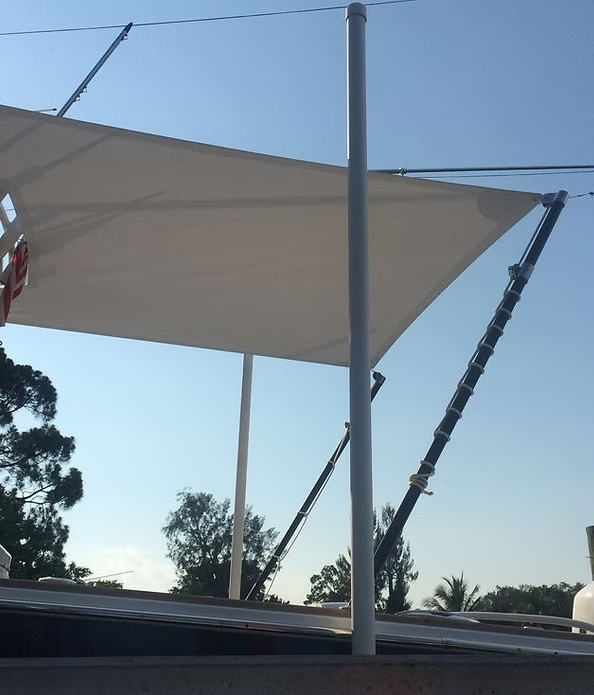
For owners who want removable coverage without drilling into the boat, a center console boat shade can be designed around existing rod holders. This allows shade poles to occupy selected mounting points while leaving other areas available for fishing.
Center console layouts provide excellent movement around the boat, but much of the deck is exposed. A T-top can cover the helm while leaving the bow, cockpit, or aft section open. Additional shade can extend coverage into these uncovered areas without requiring the entire boat to be enclosed.
The position of the shade matters just as much as its size. Coverage should be concentrated where passengers spend time while keeping the areas used for casting and handling equipment clear.
The open layout of a center console boat provides little natural protection from overhead sunlight. Passengers may move between several exposed areas during a trip, making shade useful beyond the console itself.
A removable shade panel can provide overhead protection across a selected section while preserving the open character of the boat.
A standard T-top generally provides shade around the console and helm. The bow, forward seating area, cockpit, or aft deck may remain exposed depending on the boat’s design.
A supplemental shade system can extend coverage into one of these areas without requiring a permanent structure across the entire deck.
The shade should not occupy the same space needed for casting or moving rods. Pole locations need to be selected around existing fishing positions, while the fabric should remain high enough to provide practical clearance.
A removable arrangement offers additional flexibility because the supports can be taken away when unrestricted deck access is required.
The most suitable shade position depends on how the boat is arranged and where people need protection from the sun. Coverage can be concentrated at the bow, cockpit, aft deck, or another open section.
Before installing the system, identify the areas that need shade and compare them with the locations of rod holders, seating, cleats, rails, and fishing equipment.
Bow coverage can provide shade over forward seating and lounging areas while leaving the center console and aft section open. The pole positions should allow people to move around the bow without creating unnecessary obstructions.
The height of the shade also needs to accommodate occupants while keeping adequate clearance for rods and other equipment.
Cockpit shade is useful for the section behind the console where passengers may sit, prepare equipment, or spend time between fishing activities.
Pole placement should be planned around the available rod holders so that the supports do not interfere with frequently used fishing positions.
The aft deck often benefits from additional shade, particularly on boats where the existing T-top does not extend far enough toward the stern.
A properly positioned panel can provide overhead coverage without covering the entire fishing area. The mounting points and pole length should be selected according to the dimensions of the boat.
Casting clearance should be treated as a primary design requirement. Shade fabric and poles should remain outside the paths used for casting, rod movement, and landing fish.
Using selected rod holders rather than occupying every available mounting point can help retain access to important fishing areas.
Several shade arrangements can be used on center console boats. Each has different requirements for installation, coverage, permanence, and deck access.
The choice should reflect the boat’s existing structure and how frequently the owner wants to install or remove the shade.
Rod holder shade poles use existing rod holders as mounting locations. This approach avoids drilling additional holes and allows the shade system to be removed when it is not required.
The poles support the shade fabric while a tensioning arrangement helps keep the panel positioned above the deck. Fixed-length options can be selected according to the height and coverage required.
A T-top shade extension can increase the area protected by the existing console structure. It is useful when the primary T-top provides insufficient coverage but the owner wants to retain a relatively integrated appearance.
The limitation is that the extension remains connected to the existing structure and may not offer the same removal flexibility as a standalone pole system.
Bimini-style shades use a frame to support fabric above a seating or deck area. They can provide broad coverage, but the frame can occupy more visual and physical space.
For fishing-focused boats, the frame position needs to be checked carefully to avoid restricting rod movement or casting angles.
Permanent structures can provide consistent coverage and may be appropriate where shade is required throughout most of the boat’s use.
They require more planning because mounting hardware becomes part of the boat’s fixed configuration. Owners who frequently switch between shaded cruising and open fishing may prefer a removable alternative.
Center console boats already have rod holders positioned around the deck, making them useful mounting points for removable shade poles. The system can use selected holders without requiring new holes or permanent bases.
The arrangement also keeps the shade structure relatively simple, which is helpful when deck space needs to serve multiple purposes.
A rod holder provides a ready-made mounting point for the lower end of a compatible shade pole. The pole is inserted into the holder rather than attached through a newly drilled base.
Standard 1.5-inch rod holders are used with applicable configurations, so the existing hardware should be measured before selecting the system.
Pole height and location should be chosen so rods can be moved without striking the support or fabric. This is particularly important around the bow and cockpit, where rods may be handled frequently.
A higher mounting position can provide additional clearance, but the required pole length must still match the shade dimensions and mounting geometry.
A rod holder system does not require drilling additional mounting holes for the poles. This can preserve the existing deck and avoid adding hardware solely for supplemental shade.
The approach is also useful for boats that need to switch between different deck arrangements.
The poles can be installed when shade is required and removed when an open deck is preferable. This gives the owner greater control over how the boat is configured for different activities.
The removable design also simplifies storage because the poles do not need to remain attached to the boat between uses.
The correct configuration begins with measurements rather than the pole material alone. Shade dimensions, mounting points, height, and fishing access all need to be considered together.
The intended use of the boat should also influence the setup. A fishing-focused arrangement may need more clearance, while a cruising configuration may place greater emphasis on passenger coverage.
Measure the area that needs protection and determine where the shade fabric will attach. Consider both the width and length of the required coverage.
Avoid selecting a fabric size that extends unnecessarily into casting or walking areas. The objective is useful shade rather than maximum fabric coverage.
Fixed-length shade poles are available in different sizes for different boat configurations. A six-foot pole can suit many center console applications, while longer poles may be needed where additional height or coverage is required.
The selected length should provide sufficient clearance without placing the fabric unnecessarily high above the deck.
Map the available rod holders before choosing the mounting points. Some may be needed for fishing rods, while others can be dedicated to shade support.
The spacing between holders also affects the shape and tension of the shade panel. Mounting positions should therefore be assessed as part of the complete setup.
Carbon fiber offers a strong stiffness-to-weight ratio and can be easier to handle during installation and removal. Aluminum can provide a practical alternative where material cost is a greater consideration.
Sunfly Poles offers carbon fiber and aluminum shade pole configurations for different marine applications. Sunfly Poles provides information on available pole systems and their intended uses.
A shade system is exposed to sunlight, moisture, salt, wind, and repeated handling. Regular inspection can help identify worn lines, loose fittings, fabric issues, or other problems before they affect the setup.
Maintenance does not need to be complicated. Cleaning and checking the main components after use can help preserve their condition.
Inspect the pole ends, fittings, mounting points, and tensioning hardware regularly. Look for signs of wear, looseness, cracks, or damage.
Connections should remain secure during use, and damaged components should be addressed before the shade is installed again.
The fabric should remain properly tensioned without excessive force. A loose panel can move unnecessarily, while excessive tension can increase loads on the fabric and attachment points.
Check the tensioning line and cleat regularly to ensure the system can be adjusted and secured correctly.
Salt residue can accumulate on marine hardware after exposure to seawater. Rinse suitable components with fresh water after use and allow them to dry properly.
Cleaning the fabric according to its care requirements can also help prevent accumulated salt and debris from affecting its condition.
Remove the poles and store them in a suitable dry location when the shade is not being used. Keep fittings and lines organized so they are not subjected to unnecessary abrasion.
Protective storage bags can help prevent scratches and keep the components together between installations.
The best option depends on the boat’s layout and the required coverage. Rod holder shade poles are useful where removable coverage, fishing access, and minimal permanent hardware are priorities. T-top extensions and bimini-style systems can also work where their mounting arrangements suit the boat.
Yes. A compatible rod holder shade system can use existing rod holders as mounting points. This avoids drilling new holes for the shade poles and allows the supports to be removed when coverage is not needed.
It should not when the mounting locations, pole height, and fabric dimensions are selected carefully. Rod clearance should be considered before installation, particularly around casting areas and frequently used rod holders.
The appropriate size depends on the boat’s dimensions, shade panel, mounting locations, and required clearance. Six-foot fixed poles are commonly suited to center console applications, while longer configurations may be appropriate for larger coverage requirements.
A removable shade pole system can be taken down before trailering. The poles and shade fabric should be removed and stored securely rather than left exposed to unnecessary movement or road-related forces.
Adding shade to a center console does not require sacrificing the open deck space that makes these boats useful for fishing. The placement of the poles and fabric should be planned around casting areas, rod holders, walkways, seating, and the boat’s existing structure.
Rod holder-mounted systems offer a practical arrangement for removable shade because they can use existing hardware without adding permanent pole bases. Proper measurements help determine the required coverage and pole length, while material selection can be based on handling needs, rigidity, marine exposure, and budget.
A shade system should ultimately fit the way the boat is used. Careful positioning, regular hardware checks, fresh-water rinsing, and proper storage can help keep the setup ready for repeated use. For assistance with selecting a suitable configuration, visit the contact page.