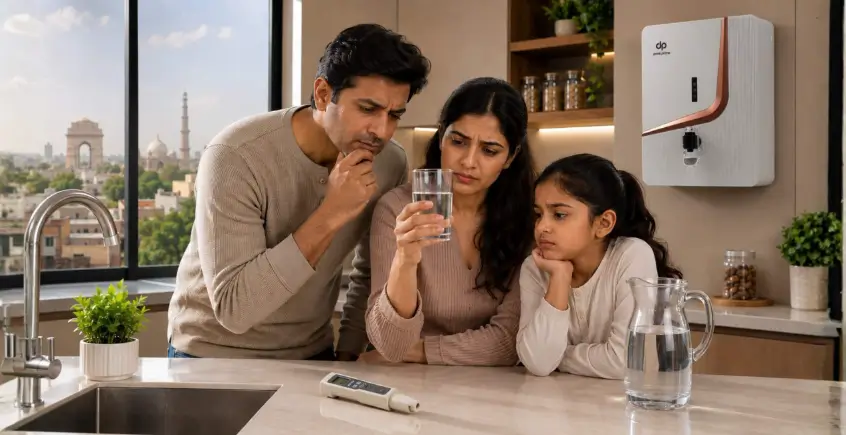

Most people buy a water purifier for home and forget about it. Install it, drink clean water, done. Except it doesn’t work like that especially in India, where the water coming into your kitchen isn’t the same all year round.
In summer, the municipal line dries up. So you switch to borewell. When that runs low, you order tanker water. Sometimes all three sources rotate within a single month. And here’s what nobody tells you at the point of purchase: each source has a different TDS level, different hardness, different sediment load. Your purifier was calibrated for one type. It’s now handling three. That’s when things start getting expensive.
Why Your Purifier Filter Lifespan Drops When the Source Keeps Changing
The best water purifier for home is designed around a general TDS range. RO membranes, sediment filters, carbon blocks they all have a rated capacity. Typically, a good RO membrane lasts about 12 months under consistent water input. Even the best water purifier for home carries that same assumption baked into its filter ratings.
But consistency is a luxury most Indian households don’t have.
Borewell water in most parts of southern and western India carries TDS levels between 500 and 2,000 ppm. Municipal supply in the same area might sit around 150 to 400. Tanker water? It’s anyone’s guess could be 300, could be 1,200, depending on where they sourced it. When your purifier swings between these inputs week to week, the membrane works harder on high-TDS days and barely gets a break in between.
The Hidden Cost Nobody Calculates Before Buying
Here’s where it gets quietly painful. A sediment filter replacement costs around ₹300 to ₹500. The RO membrane is ₹1,500 to ₹3,000. Carbon filters sit somewhere in between. If your water source is stable, you’re looking at one round of replacements per year maybe ₹2,500 to ₹4,000 total, including the technician visit.
Now imagine the source changes three or four times a year. Your sediment filter clogs in two months instead of six because tanker water carried silt the RO wasn’t expecting. The membrane degrades faster because it spent three weeks processing 1,800 TDS borewell water after months of 200 TDS municipal supply. You call the technician again. And again.
By the end of the year, you’ve spent ₹7,000 to ₹10,000 on maintenance alone. For context, that’s nearly half the price of a mid-range water purifier for home. But most people don’t connect the dots because the costs trickle in a filter here, a service call there. It never feels like one big expense until you add it up in December.
What Makes Multi-Source Water So Harsh on Standard Purifiers
It’s not just TDS variation. Each water source brings a different kind of problem.
Borewell water is typically hard. High calcium, high magnesium. It scales up the membrane and the internal tubing faster than anything else. You’ll notice white deposits on your utensils first, then inside the purifier if you open it up during servicing.
Municipal water is treated, yes, but often carries residual chlorine and occasionally bacterial contamination from leaking distribution pipes. The activated carbon filter takes the hit here, wearing down faster than it should.
Tanker water is the wild card. It can carry high sediment, inconsistent TDS, and sometimes organic contaminants depending on the source. If the tanker filled up from a poorly maintained open well (and this is more common than anyone admits), your sediment filter is essentially doing overtime it wasn’t sized for.
When a single water purifier for home encounters all three within the same quarter, no single stage of filtration gets a consistent workload. Everything degrades unevenly. That’s what makes multi-source supply so punishing.
See also: How to Treat Foot Neuropathy When Home Remedies Stop Working
Purifiers That Adapt to Changing Sources Actually Exist Now
For years, the advice was just “get your water tested and buy accordingly.” Good advice if your water never changes. Useless if it does.
Newer models have started addressing this. Some purifiers now come with TDS sensors that detect incoming water quality in real time and adjust the purification process blending RO-treated water with UV or UF-treated water based on the input TDS. That matters more than people realise, because over-purification is a problem too. Running low-TDS municipal water through a full RO cycle strips minerals unnecessarily and wears the membrane without good reason.
The smarter water purifier for home options today don’t just filter. They sense, adjust, and protect their own filters from premature wear. The technology exists. The question is whether buyers know to look for it, because most salespeople won’t bring it up unless you ask.
If your home genuinely deals with two or three water sources across the year and that’s most urban and semi-urban homes in India this is worth paying attention to. Not because it’s fancy, but because it directly cuts your maintenance bill by extending filter life. Practically, that means fewer technician visits, fewer membrane replacements, and a machine that doesn’t silently degrade six months in.
Conclusion
The real cost of a water purifier for home isn’t the sticker price. It’s what you spend keeping it functional when your water supply refuses to stay constant. Borewell, municipal, tanker each one stresses the system differently, and switching between them accelerates every part of the maintenance cycle. The fix isn’t more frequent servicing. It’s choosing a purifier that was built to handle inconsistency from day one, so your filters last as long as they were actually meant to.