Newsletter Subscribe
Enter your email address below and subscribe to our newsletter
Enter your email address below and subscribe to our newsletter

 ByJohn A
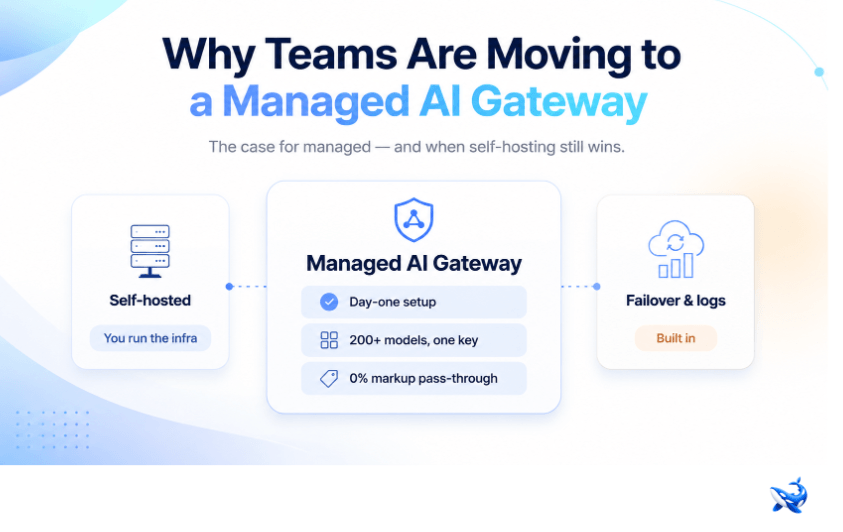
The shortest honest version: ai gateway is the fastest way to get production-grade routing, failover, and observability without running any of that infrastructure yourself — and for the cost questions that usually slow the decision down, the rate card for Claude Sonnet 5 shows what the mid-tier actually costs per million tokens when list prices pass through unchanged. The category decision most teams actually face is no longer “do we need a router at all” — it’s whether to buy it as a service or build and host it yourself. This piece walks through the case for managed, the honest cost math, and the specific situations where self-hosting genuinely still wins.
The default posture two years ago was “we’ll run our own gateway.” It was a reasonable instinct: more control, fewer moving parts outside the wall, and a bill that looks smaller on paper. Then the models kept multiplying — frontier labs shipping new flagships, small and medium models getting shockingly good, price cuts landing mid-quarter — and the thing teams were self-hosting turned out to be a continuously moving target. The infrastructure itself is not the hard part. Keeping it current is.
Self-hosting an AI gateway is a project. You deploy the service, wire it into your CI/CD, manage the config, handle the certificates, set up the retry logic, build the failover that actually triggers when a provider blips, and then — the part everyone underestimates — keep it maintained as models and vendors churn. That is weeks of engineering time before your application sees a single routed request.
A managed gateway flips that timeline. Because the gateway is already running, provisioned, and connected to every major provider, the integration is the API key. One key gets you access to 200+ models across vendors including OpenAI, Anthropic, Google, Meta, Mistral, xAI, DeepSeek, Qwen, GLM, and MiniMax [OURS — OrcaRouter product pages, verified 2026-08-22]. You point your client at the endpoint, and routing, retries, and fallback exist on day one instead of after a sprint. For most teams the project-management math alone settles it: weeks of self-hosted engineering vs. an afternoon.
The recurring cost of self-hosting isn’t the first deploy. It’s that the valuable capabilities end up being your backlog. Consider what a production gateway actually needs:
• Automatic failover. When a provider degrades or returns errors, requests need to flow to a healthy model without a page on call. A managed gateway makes failover part of the default routing behavior [OURS]. Building this yourself means writing health checks, tracking per-provider error rates, and testing the failure path — the most skipped and most important code in the whole setup.
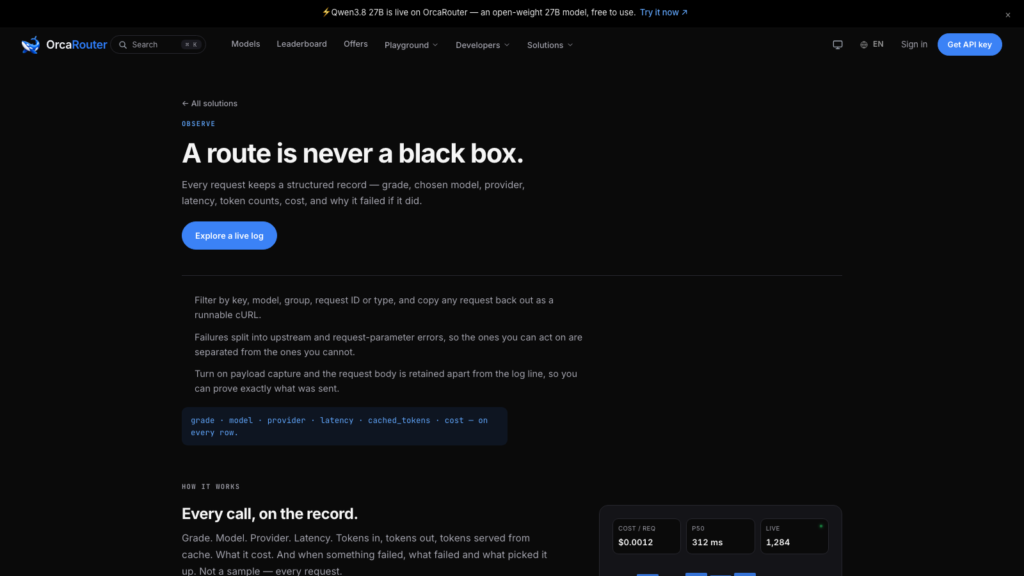
• Request logs and observability. Teams adopt a gateway for routing and stay for the logs. Per-request logging — which model answered, how fast, at what cost — is what turns an LLM bill from a mystery into an audit trail [OURS — OrcaRouter request-logs product page]. Self-hosting this means shipping logs, storing them, and building the query surface. That’s a data platform, not a gateway feature.
• Caching and rate governance. Prompt caching at the gateway and budget/role controls (per-team limits, spending caps) are table stakes for scaling past a single internal app [OURS].
None of these are one-time projects. Each is a subsystem with its own failure modes, and together they form the real maintenance load of self-hosting.
This is the burden that’s hardest to see from the “we’ll host it” side: infrastructure availability is now your responsibility, 24/7. Your gateway is a single point of failure, and if your app’s traffic depends on it, its uptime is your uptime. Self-hosting that reliably means running the service in multiple regions, managing deployments, watching capacity, and answering the 3 a.m. page when egress costs spike or a region degrades.
With a managed gateway, uptime and egress are the provider’s problem, which is precisely their core business. You inherit the economies of scale of a service whose whole reason to exist is routing traffic well. That is not a trivial advantage — for most teams it is the difference between shipping features and running infrastructure.
Every provider you integrate adds an account, a contract, and a billing cycle. Three models across two vendors is already annoying; a dozen models across five vendors is a reconciliation exercise every month.
A managed gateway consolidates that into one account and one invoice covering every model you touch. The “one bill” argument matters more than it sounds, because it changes how you think about cost: instead of comparing line items across vendors, you compare what you spent this month against what you shipped. And because the gateway sees every request, cost attribution becomes a per-model, per-team question answered from the request logs, not a spreadsheet guess.
This is the objection most worth taking seriously, because historically it was true. The managed model usually meant paying a layer of margin on top of provider list prices — you paid for convenience in both money and lock-in. That was a fair trade for some teams and a genuine dealbreaker for others.
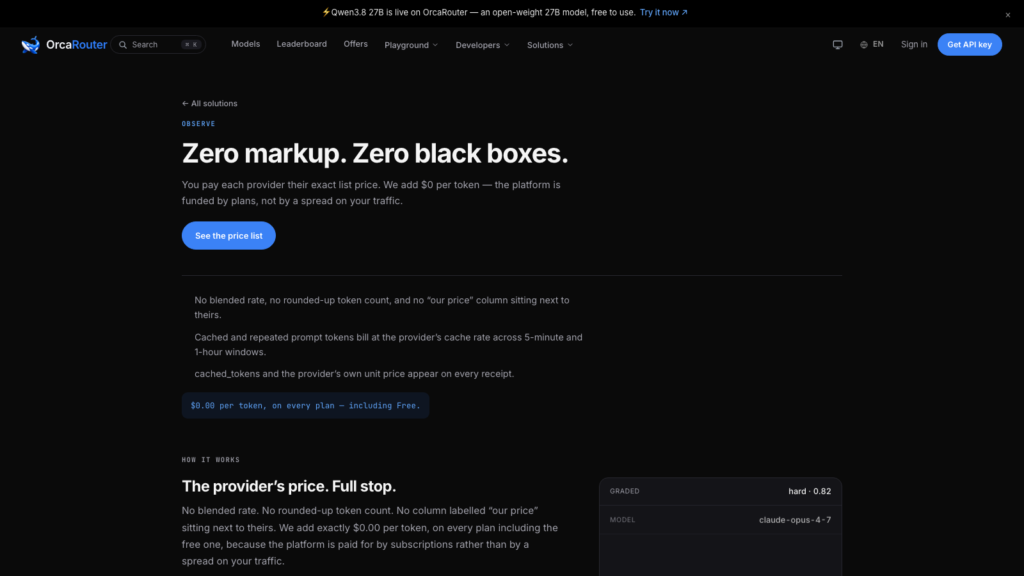
The market has moved. Managed now includes providers that pass the vendor list price through unchanged — the provider’s price, with no added $0.00, and itemized receipts showing exactly what you paid per request [OURS — OrcaRouter zero-markup-cost product page]. OrcaRouter’s position is 0% markup: you pay the list price the model vendor itself publishes, and the gateway’s own service cost is visible rather than hidden inside per-token pricing [OURS]. When that’s the model, the cost-at-scale objection collapses — a managed gateway is no longer “list price plus a middleman,” it’s list price with routing, failover, and logging attached at a transparent cost.
That changes the table below, which is the comparison most teams actually make:
| Decision factor | Managed AI gateway | Self-hosted gateway |
| Time to first routed request | Hours — one API key | Weeks — build + deploy + harden |
| Failover, retries, request logs | Built in, on day one | You build and maintain them |
| Uptime and egress | Provider’s responsibility | Your on-call rotation |
| Billing | One account, one invoice | Per-vendor accounts and contracts |
| Cost per token | Provider list price, transparently passed through | Provider list price + your infra and engineering time |
| Control and customizability | Service-level knobs and config | Full code-level control |
The managed argument deserves pushback, so let’s make the honest counter-case. Three objections come up reliably.
“I lose control.” Partly fair, but the control you’re giving up is mostly infrastructure control — which most teams neither want nor use. Application-level control (routing policy, model selection, budgets, BYOK, guardrails) is exactly what a managed gateway exposes [OURS]. What you don’t get is the code. If your differentiation depends on writing custom gateway internals, self-hosting is defensible. If your differentiation is your product, it isn’t.
“It’s more expensive at scale.” This was the strong version of the objection and it’s the one the zero-markup model defuses. If the gateway passes list price through with no added markup [OURS], the per-token cost is the same as calling the vendor directly — you’re paying for the routing layer as a separate, visible service rather than as a hidden margin. At scale the question becomes whether the engineering time you’re not spending on gateway maintenance is worth more than the self-hosted infra bill. For most teams it is.
“Compliance.” Legitimate, and the answer is a real one: managed vendors now offer BYOK (bring your own key), so traffic can flow through the customer’s own provider accounts, plus role-based budgets and per-request audit logs [OURS]. That combination — your keys, your limits, a complete request trail — covers the standard enterprise objections. The remaining edge cases, where data must never leave a specific environment, are exactly the “self-hosting genuinely wins” bucket below.
See also: How to Use a Fumot Vape Effectively: A Technology-Focused Guide
Be clear-eyed about this, because the honest answer to “should we self-host?” is sometimes yes. Self-hosting wins when:
• Data residency is non-negotiable. If policy forbids requests touching any external infrastructure, no managed gateway — regardless of features — is the answer.
• You’re a platform company. If your product is the gateway, or if routing is your core IP, you should run it.
• You have the headcount and a genuine, sustained volume problem. At very large scale, teams with dedicated infrastructure engineers can run a gateway more cheaply than a service fee — though that math should include the engineers’ full time, not just the cloud bill.
• You need deep code-level customization. If your routing logic is genuinely exotic — not a DSL or configuration, but new algorithms — self-hosting may be the only path.
That’s a real list, and it’s worth checking yourself against it honestly. But notice what it excludes: “we want to save money,” “we want control,” and “we’re worried about compliance” — the three reasons most teams cite — are exactly the ones a modern managed gateway addresses with transparent pricing, real governance features, and a fully auditable request trail.
The self-hosted-vs-managed gateway decision comes down to one question: is routing your product, or is your product the thing that uses routing? If it’s the former, self-host and enjoy the control. If it’s the latter — and it is for nearly every team shipping an application that calls models — a managed gateway gets you automatic failover, per-request logs, and one key for 200+ models on day one, at provider list price with no markup [OURS]. Start there, verify it on your own workload, and revisit self-hosting only if a hard requirement — residency, IP, or exotic customization — actually forces you to.
Sourcing note: All product facts, including the single API key for 200+ models, the 0% markup pass-through of provider list prices, automatic failover, per-request logging, BYOK, and budgets/roles, are OrcaRouter’s own published claims from its product pages (homepage and /solutions/zero-markup-cost and /solutions/request-logs), verified August 22, 2026. No third-party routing providers or inference marketplaces are cited. The managed-vs-self-hosted trade-off framing is general industry practice, not attributed to any named vendor.