
Blind spots are the quiet enemy of every security system. You cover the door, then the register, then the back hallway, and somehow the corner where things go missing is still out of view. A 360 fisheye security camera solves that by seeing the whole room at once. Here is how it works, where it fits best and what to check before you buy.
What is a 360 fisheye security camera?
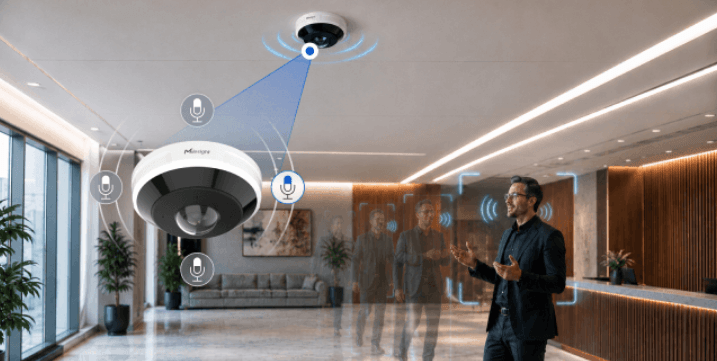
A fisheye camera uses an ultra-wide lens that captures a full 360-degree view from a single point. When mounted on a ceiling, it records everything around it, like looking down at a whole room from above. When mounted on a wall, it typically covers around 180 degrees.
Instead of buying and wiring four cameras for a square room, you install one. That saves on cable, switch ports, NVR channels and installation time.
How the image looks and what dewarping does
The raw image from a fisheye lens looks like a circle, with the center looking down at the floor and the edges curving. That is normal. To make the footage easy to use, the camera or recorder applies dewarping, which flattens the image into more natural views.
Common view modes include:
- Fisheye (original) view: the full circular image
- Panorama: a flattened wide strip, usually 180 or 360 degrees
- Quad view: four separate flattened views from one camera
- PTZ view: a digital pan, tilt and zoom within the image
Dewarping can run on the camera itself or on the NVR or software. Check which one your system supports, because it affects how you review and export footage.
Why resolution matters even more here
A fisheye camera spreads its pixels across a very wide area. A 4MP fisheye gives you far less detail per area than a 4MP regular camera. For that reason, higher resolution is more important on fisheye models, and 8MP to 12MP units are popular for serious coverage. The extra pixels help when you zoom into one part of the room after dewarping.
Best places to use a fisheye camera
Fisheye cameras shine in open indoor spaces where you want to see everything.
- Retail stores and showrooms
- Restaurants, cafes and bars
- Lobbies, reception areas and waiting rooms
- Warehouses and storage areas
- Classrooms, gyms and meeting rooms
- Hallway intersections and elevator lobbies
They also work well in small outdoor areas such as courtyards and covered patios, as long as the camera is rated for the weather.
Ceiling mount vs wall mount
Ceiling mount gives true 360-degree coverage and the most efficient use of one camera. It is the best option for a room where you want to see every angle.
Wall mount gives a wide, panoramic view of the space in front of the camera, usually around 180 degrees. It works well for long rooms and hallways.
Choose based on the room layout. In a rectangular room with a central ceiling spot, ceiling mounting usually wins.
Limits you should know about
Fisheye cameras are excellent for awareness, but not perfect for every job.
- Distance detail is limited. Faces far from the lens appear small. Use a fisheye for coverage, not for identifying people across a big space.
- Edges are stretched. Image quality drops toward the outer edge, even after dewarping.
- High ceilings reduce detail. The higher the lens, the smaller everything looks.
- Recorder support varies. Make sure your NVR and software handle fisheye and dewarping, or you will end up with a distorted view.
The best combination: fisheye plus fixed cameras
The smartest setups combine a fisheye with other camera types. The fisheye gives you the big picture of the room. Fixed cameras at entrances, registers and exits give you close-up faces and details. If something happens, you use the fisheye to understand the scene and the fixed cameras to identify who was involved.
Installation tips
- Mount it near the center of the room for even coverage
- Keep it away from ceiling fans, which cast moving shadows
- Avoid direct light sources that shine into the lens
- Use PoE for a clean install with a single cable
- Check the firmware and recorder compatibility before mounting
- Test dewarped views before you finish, and adjust the height if needed
What to check when you buy
Look at the resolution, the field of view, night vision range, indoor or outdoor rating, built-in microphone or SD card support, and NVR compatibility. If you work with government or contractor sites, confirm NDAA compliance too. A fisheye with smart features such as people counting or heat mapping can also add value in retail.
Final thoughts
A 360 fisheye security camera is one of the most efficient ways to cover an open space. It reduces blind spots, saves on equipment and cabling, and gives you flexible viewing options after the fact. Pair it with fixed cameras for identification, choose enough resolution, and check recorder support before you buy. Browse the fisheye and multi-lens range to find a model that fits your room.